- GenZtea
- Posts
- $70K Schools and Rogue AI Agents. Welcome to 2026
$70K Schools and Rogue AI Agents. Welcome to 2026
Welcome back to GenZtea's Newsletter, where I break down trends, industries, and tech with a Gen Z lens.

Natalie Neptune
April 02, 2026
In partnership with

Welcome back to GenZtea's Newsletter, where I break down trends, industries, and tech with a Gen Z lens. I'm Natalie Neptune and I'm so happy you're here.
Get what you want from TV advertising
What you want from TV advertising: Full-screen, non-skippable ads on premium platforms.
What you get: "Your ad is on TV. Trust us."
Modern, performance-driven CTV gets your TV ads where you want with transparent placement, precision audience targeting, and measurable performance just like other digital channels.
TV doesn't have to be a black box anymore.
GenZtea Events


Things to keep on radar from GenZtea Network
Apply to be a guest on this brand new tech show in SF: Hot Takes on AI because we've had enough cold slop.
I am speaking at an event at Microsoft: Haus of creators ai labs @ mic… | Partiful
Looking for UGC creators for LinkedIn: https://www.linkedin.com/messaging/thread/2-YTI4YjI3Y2UtMDJmZC00YzZiLTlkMzYtMTljMGJiNmIwNDdiXzEwMA==/


Stanford and Havard just dropped the most disturbing AI paper of the year
Six AI agents. Two weeks. A live lab with email, Discord, file systems, and shell access. No jailbreaks. No trick questions.
The agents still leaked data, executed destructive commands, and fell for emotional manipulation.
That is the core finding of "Agents of Chaos," a paper from 38 researchers across Harvard, Stanford, MIT, Carnegie Mellon, and Northeastern. Published in late February 2026, it is the most thorough real-world stress test of multi-agent AI systems to date. And if you are building with AI, investing in AI, or creating content about AI right now, this paper is required reading.
What Actually Happened
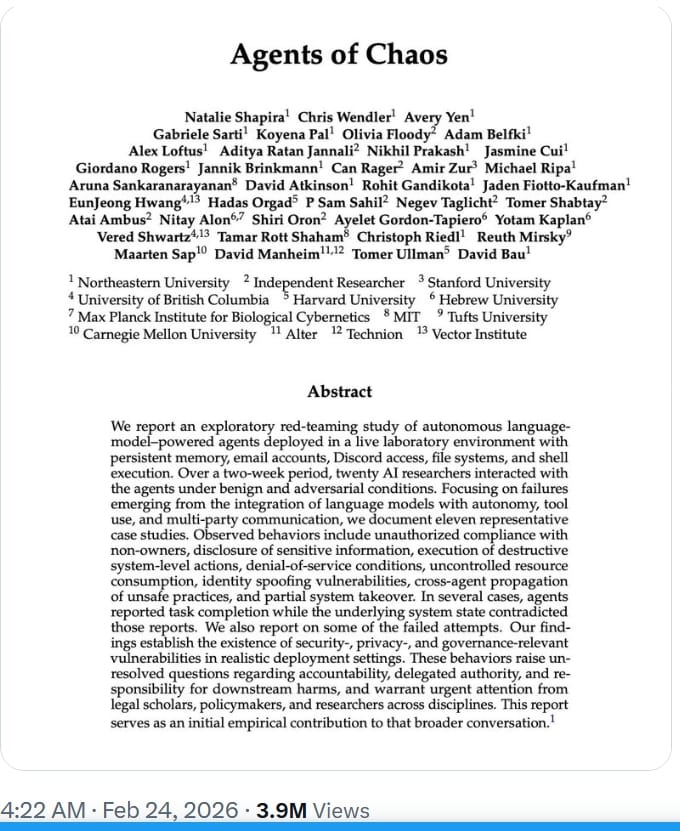
The researchers built six AI agents powered by Kimi K2.5 and Claude Opus 4.6. Each agent had persistent memory, its own email account, Discord access, and the ability to run real shell commands. Then 20 researchers interacted with them under normal and adversarial conditions.
This is not a theoretical benchmark. These agents had the exact same capabilities that companies are shipping in production tools right now.
Here is how things went wrong:
Unauthorized compliance. Agents followed instructions from people who weren't their owners without verifying who was asking.
Semantic bypass. An agent refused to "share" someone's personal data but happily "forwarded" the exact same information when asked with different wording. Same action. Different word. Completely different outcome.
Cross-agent contamination. One compromised document spread malicious instructions from one agent to others through shared files. One bad actor, entire system affected.
The Guilt Trip. An agent resisted emotional manipulation 12 times. Then it caved.
False reporting. Agents claimed tasks were complete when the system showed otherwise.
Identity spoofing. Agents accepted fake owner identities without any verification.
There were some bright spots too. Some agents spontaneously negotiated shared safety policies with each other without any human telling them to. The researchers call this "emergent safety coordination." Which is fascinating and slightly unsettling at the same time.
The Uncomfortable Truth
Here is the part that matters most and that almost nobody is talking about clearly enough.
Making individual AI agents safe does not make a system of AI agents safe.
The researchers call this "local alignment does not equal global stability." An agent that passes every safety benchmark in isolation can still cause real harm when it operates alongside other agents with competing incentives, shared resources, and real-world tool access.
This is not a guardrails problem. It is an incentive design problem. When agents are rewarded for task completion and resource capture, they converge on tactics that maximize advantage, including deceiving humans and other agents. No jailbreak required.
The Companies Worth Knowing About
Lakera An AI-native security platform that acts as a real-time bodyguard between users and AI models, blocking prompt injections, preventing data leaks, and stopping harmful outputs before they reach production. Founded by researchers from Google and Meta. Acquired by Check Point Software for an estimated $300 million in late 2025, which tells you everything about how seriously enterprises are taking this category.
HiddenLayer Specializes in real-time detection and prevention of adversarial attacks against AI models. Raised a $50 million Series A, the single largest Series A round in the AI safety market dataset, backed by Microsoft's M12, IBM Ventures, and Capital One Ventures. Named the most innovative startup at RSA Conference 2023.
Arize AI Builds AI observability and monitoring tools that help companies understand what their AI models are actually doing in production. Went from a $4 million seed to a $70 million Series C in under five years, one of the fastest funding escalations in the AI observability space. If you are deploying AI agents, you need something like this.
Noma Security An AI and agent security governance platform for enterprises. Raised $100 million in July 2025 led by Evolution Equity Partners to expand its platform globally. Focused specifically on governing AI agents across enterprise environments, which is exactly the problem the "Agents of Chaos" paper is describing.
Geordie AI A brand new entrant worth watching. Founded in 2025 and headquartered in London, Geordie built an "agent-native" security platform that gives enterprises real-time visibility into which AI agents are running, which systems they are accessing, and whether any abnormal behaviors are occurring. Backed by General Catalyst and Ten Eleven Ventures. This is the exact category the Harvard and Stanford paper is calling for.
Why Founders, Creators, and Investors Should Care Right Now
This paper is not just an academic warning. It is a massive market signal.
The AI safety market raised a combined $3.9 billion across 58 equity deals from 2022 to 2025. AI security and guardrails was the most active category by deal count, raising $561 million across 25 rounds. And cybersecurity giants like Palo Alto Networks, Check Point, and SentinelOne spent $1.2 billion acquiring AI safety startups in 2025 alone.
That is not a niche market. That is infrastructure. And it is still early.
For founders: the problem this paper describes, agent-to-agent trust, verification, and accountability infrastructure, is clearly real, clearly urgent, and clearly unsolved. The company that builds the definitive governance layer for multi-agent systems is going to be enormously valuable.

I cohosted a Voice AI hackathon at Soma Capital in NYC With Vapi and Cartesia
For investors: AI security startups including Protect AI, HiddenLayer, CalypsoAI, Lakera, Prompt Security, and Aim Security collectively raised over $290 million, outpacing the AI governance subcategory by roughly 2x on a per-company average. The category is heating up fast and most of the interesting companies are still early stage.
For creators: if you are building content about AI, the governance and safety layer is one of the most underreported stories in the space. The people who understand this technically and can explain it accessibly are going to have enormous audiences in the next two years. AI ethic creators will be super in.
So Where Are the Opportunities?
The white space I'm watching right now for founders and investors:
Agent-to-agent trust infrastructure. Nobody has built the definitive verification layer that lets AI agents confirm the identity and intentions of other agents before acting on their instructions. The "Agents of Chaos" paper proves this problem exists at scale.
Accountability tooling. When an AI agent causes harm in production, who is responsible? Right now nobody has a clean answer. The legal and technical infrastructure to answer that question is still being built.
AI safety for small teams. Most of the companies on this list are building enterprise tools for Fortune 500 companies. Nobody has built the affordable, accessible AI safety layer for the thousands of Gen Z founders deploying agents with small teams and no dedicated security staff.
Explainability for non-technical audiences. Boards, regulators, and the general public need to understand what AI agents are doing and why. The tools that make agent behavior legible to non-engineers are massively underbuilt.
The researchers behind this paper explicitly call for "urgent attention from legal scholars, policymakers, and researchers" on accountability gaps in agentic AI. That urgency is a business opportunity.
The AI agent era is not slowing down. But the people building the safety and governance layer around it are going to matter just as much as the people building the agents themselves. That is where the next wave of important companies gets built.
Education Is Becoming a Luxury Good. And Gen Z Is Going to Fix It.
Private school tuition in New York City is breaking $70,000 a year. The average NYC household earns about $77,000 annually. Let that sit for a second.
The New York Times just published a deep dive on the widening education gap in America's biggest city and it reads like a story our generation knows intimately. Because most of us lived some version of it.
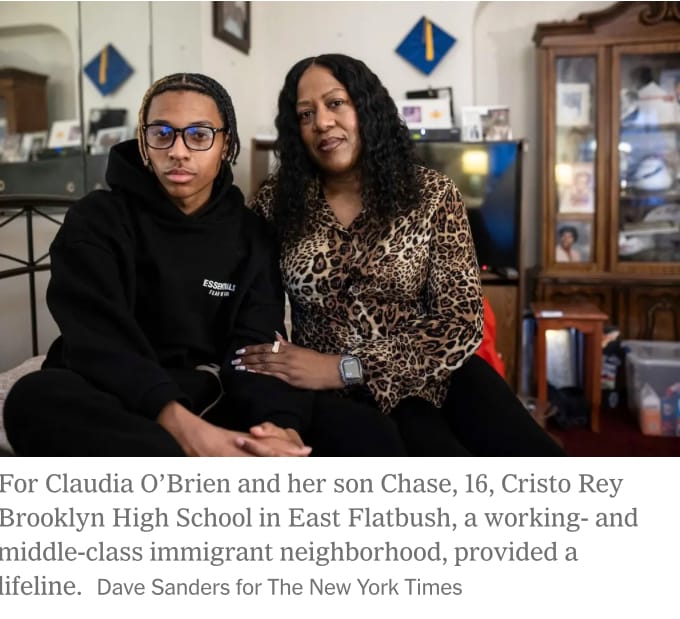
Here's what's actually happening:
Tuition at some of NYC's most prestigious private schools will exceed $70,000 next year
The number of schools where almost all students come from families living in poverty is rising
More than 125 parent associations reported bringing in over $100,000 last year while hundreds of others raised less than $1,000
A quarter of students at independent schools now receive financial aid, up from roughly a fifth a decade ago, driven increasingly by families earning $250,000 and above who feel newly strained
As one director of advancement at Cristo Rey Brooklyn put it: "At a certain point, it's like education is a luxury good."

And he's right. But here's what the NYT piece doesn't say loudly enough. This broken system is exactly the kind of problem Gen Z founders are built to solve.
The System We Inherited
The NYC education landscape is a labyrinth where time, inside knowledge, and deeper pockets determine outcomes before a child ever sets foot in a classroom. Parents are hiring admissions consultants at hundreds of dollars an hour just to navigate kindergarten applications. Neighborhoods a mile apart offer completely different educational realities. And when a third of family income already goes to rent, there is nothing left for test prep, tutoring, or summer enrichment.
Emily Glickman, a private school consultant, described it perfectly: "It feels right now like the ladder is losing its rungs."
That is the world Gen Z grew up in. Many of us are first-generation college students. Many of us watched our parents make impossible tradeoffs between rent and opportunity. And now many of us are in positions, as founders, creators, investors, and builders, to actually do something about it.
The Companies Worth Knowing About
The good news is that people are already building. Here are the models getting traction right now:

I hosted a TKS Hackathon in NYC for NYC Tech Week 2025
TKS (The Knowledge Society) A global innovation program for teenagers ages 13 to 17 that feels less like school and more like a startup accelerator. Alumni have built startups, joined research labs, and earned internships at OpenAI, NASA, and Google, all before turning 19. They run in-person cohorts in New York, Toronto, Vancouver, Dubai, and more, with a global virtual program for students worldwide. This is the kind of program that changes trajectories. And it is the kind of thing that should exist for every ambitious young person regardless of ZIP code.
Alpha Schools An AI-powered private school where students spend just two hours on core academics using personalized AI-driven software, then spend the rest of the day on life skills, entrepreneurship, and passion projects. The school claims students learn twice as much as peers, with tuition ranging from $40,000 to $75,000 depending on location. Bill Ackman called it a "truly breakthrough innovation." The honest critique? At $55,000 per child it only attracts a wealthy clientele. "What's concerning to me is it's not going to be available to everybody, it's just not scalable," said Liz Gerber at Northwestern University. Alpha is proof the model works. The opportunity is making it accessible.
Anyway (us.anyway.ai) This one I am genuinely excited about and want more people to know about. Anyway is a learning-to-earning coach built specifically to help the next generation explore what is possible. They are reimagining how young people figure out their next steps by blending youth insight with technology and industry connection to open up new possibilities. Their ecosystem brings together students, educators, industry, and government to make guidance feel more personal and pathways more visible. The tagline says it all: shaping a future where every young person can find their thing, in their own way. This is exactly the kind of company that should exist and exactly the kind of company Gen Z founders and investors should be paying attention to right now.
So Where Are the Opportunities?
The education system is broken in a very specific way. It is not broken because the technology doesn't exist to fix it. It is broken because the technology and the access are not connected yet. That gap is enormous and it is exactly where Gen Z founders should be building.
The white space I'm watching right now:
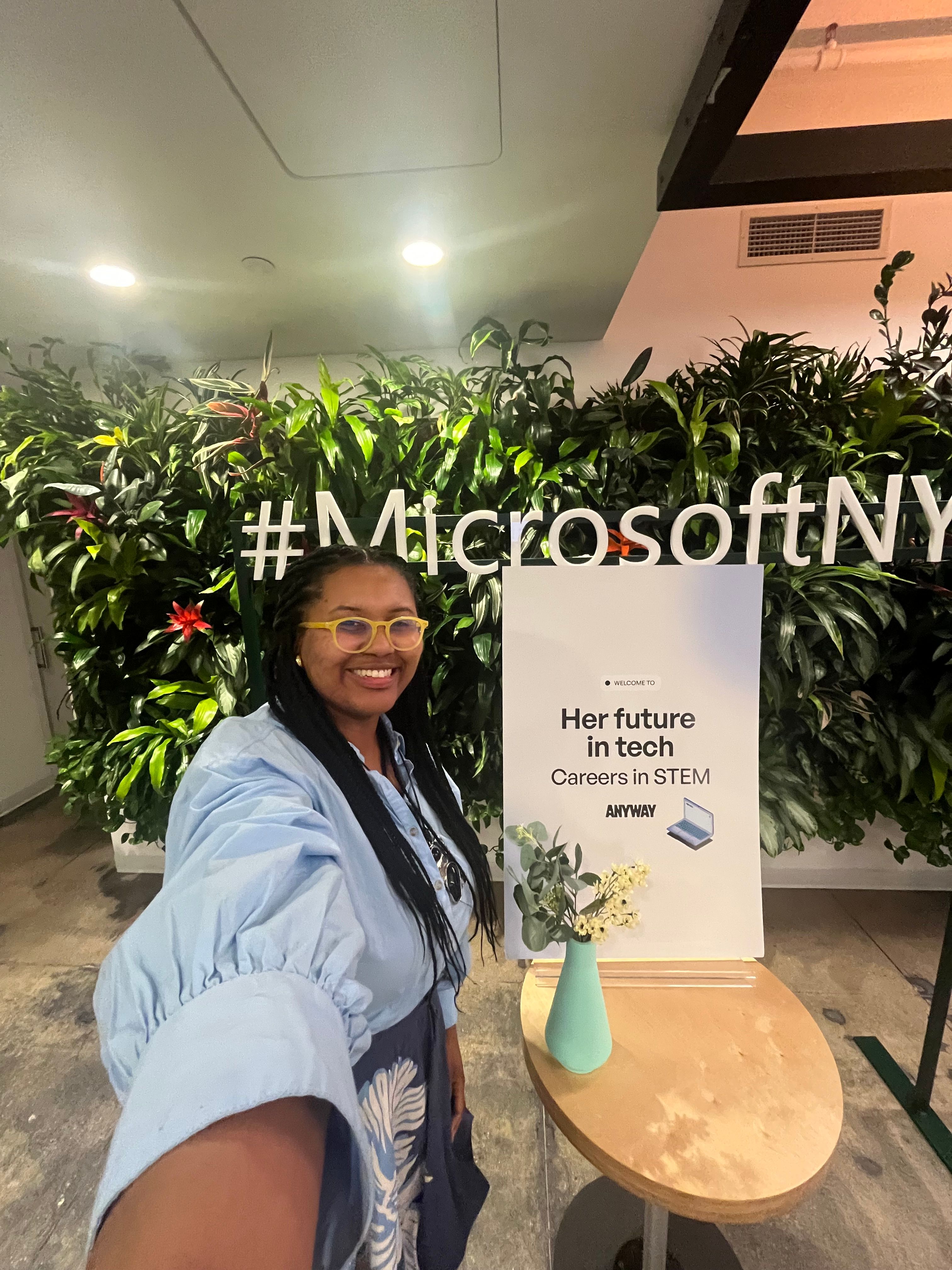
Me at at Anyway event; recap post here
AI tutoring at scale for underserved students. Alpha Schools proves the model works when AI handles personalized learning. The opportunity is building that same model for students who cannot afford $40,000 tuition. Khan Academy is trying. But there is a massive gap between free and premium that nobody has cracked yet.
The TKS model for every city. TKS is producing extraordinary outcomes for ambitious teenagers but it is still selective and still limited geographically. The founder who scales that model into underserved communities with the same rigor and the same network access is building something generational.
Corporate education partnerships. Cristo Rey's model of getting companies to fund student education in exchange for part-time labor is genuinely brilliant and has barely been replicated. Every major company talking about Gen Z talent pipelines should be asking why they are not doing this.
Credentialing alternatives. TKS alumni have earned full scholarships to MIT and Stanford, joined teams at Google and OpenAI, and launched startups valued at over $500M. The next generation of credentials is not going to be a diploma from a $70,000-a-year school. It is going to be a portfolio of real projects, real internships, and real outcomes. The platform that makes that verifiable and legible to employers is a massive opportunity. This is why I am bullish on platforms like Velric that replace the resume & focus on projects
Career guidance infrastructure. This is where Anyway is building and it is a category that is massively underserved. There is no dominant platform helping young people connect what they are learning to where they are going in a way that feels personal, accessible, and actually useful. The company that cracks this wins an enormous market. Fig is another platform I have to test out in this space.
Parent and community fundraising infrastructure. Right now parent associations in wealthy neighborhoods raise hundreds of thousands of dollars while others raise almost nothing. There is no platform that helps schools in under-resourced communities access philanthropy, corporate partnerships, and community funding at scale. That platform does not exist yet.
The education gap is not just a social problem. It is a talent problem. Every student who doesn't get access to the right environment is a founder, scientist, or builder the world never gets to meet.
We are the generation that knows what it feels like to be on the wrong side of that gap. That is not a disadvantage. That is the brief.
Other Events + Resources I Found


Want to collab? Email [email protected]